How to Choose a Tampa HVAC Contractor

By Aaron Hurlburt · Last reviewed 2026-11-12
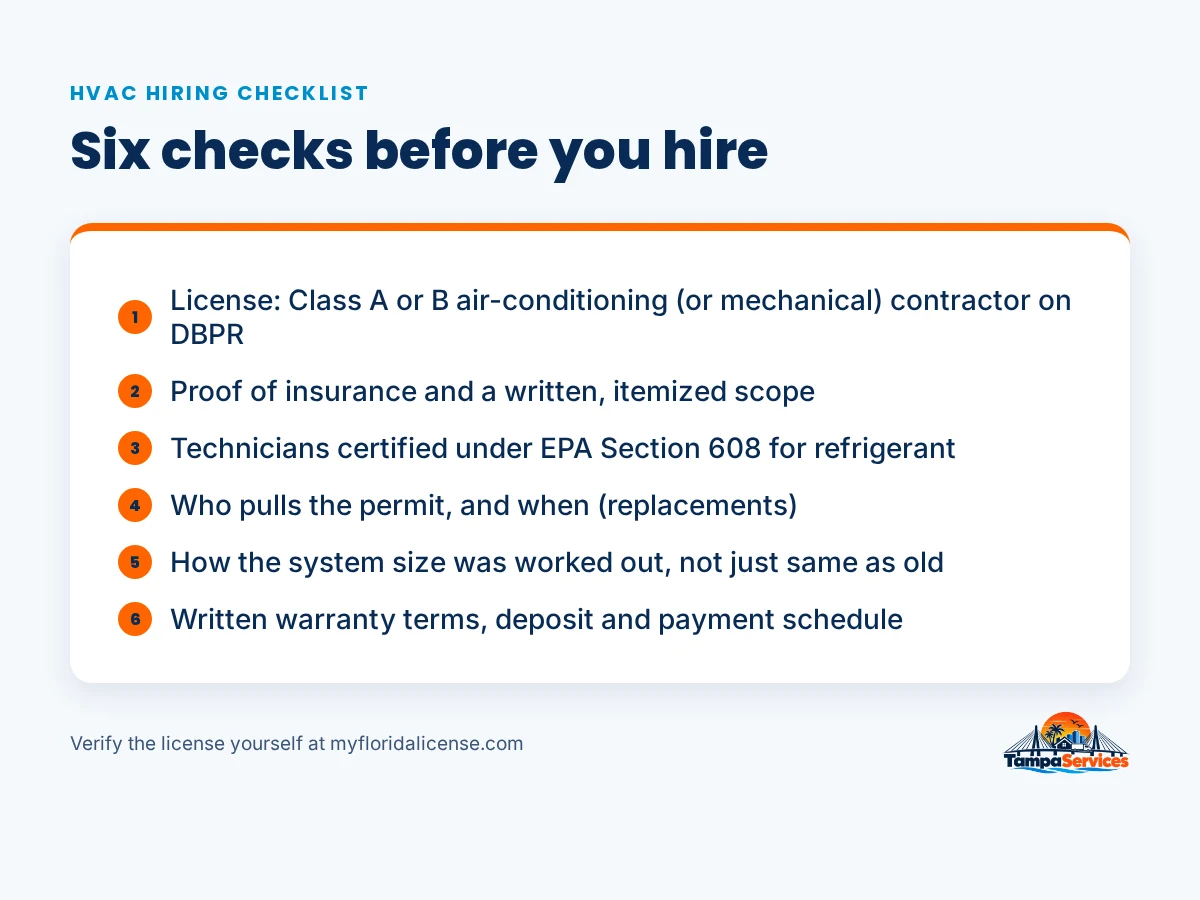
Six checks before you hire an HVAC contractor in Tampa: Florida license class, insurance, EPA refrigerant certification, permits, sizing and warranty.
The short answer: verify the license, then compare the written scope
In Florida, air-conditioning work is licensed. Check that the company's qualifying contractor holds an air-conditioning (Class A or B) or mechanical contractor license on the state's DBPR site, then compare quotes on the same written scope rather than on price alone.
Tampa Services is a marketplace, not an HVAC company. If you request help, we match you with one eligible local provider, who works under their own license. We cannot promise a response time.
Which Florida license should an HVAC contractor hold?
Florida Statutes 489.105 defines Class A and Class B air-conditioning contractors and mechanical contractors. Class B is limited to systems up to 25 tons of cooling and 500,000 Btu of heating, which covers homes and many small businesses. A certified contractor can work anywhere in the state; a registered contractor may work only in the jurisdictions where registered. Look the company up on DBPR, confirm the license is active and ask who the qualifying agent is.
What about insurance and the written scope?
Ask for proof of insurance and confirm it is current with the insurer. Then ask for an itemized written estimate: equipment brand and model, what is being replaced or repaired, duct work, thermostat, disposal of old equipment and who handles permits. Quotes are only comparable when they cover the same work.
Why does EPA Section 608 certification matter?
Federal rules require technicians who work with refrigerant to hold EPA Section 608 certification. It is reasonable to ask whether the technician who will service your system is certified. A missing answer is a reason to keep looking.
Permits and sizing: two questions that separate careful from careless
Replacing a system generally involves a permit and inspection. Ask who pulls it and confirm the requirements with City of Tampa Construction Services or your county. Also ask how the new system's size was determined. A good answer looks at your home, such as its size, shade, insulation and ducts, not only the size of the old unit. An oversized or undersized system can run poorly.
Warranty, deposits and paperwork
Get the equipment warranty and the contractor's labor warranty in writing and ask what voids either. Ask how much deposit is required and when payments are due. Florida law limits some contractor deposits, so review the statute and walk away from pressure to pay in full up front.
Business owners: same checks, plus downtime
For a shop or small office, add questions about working outside business hours and about service on larger rooftop units. Systems over 25 tons need a Class A or mechanical license. Our commercial HVAC guides cover this in more detail.
Frequently asked questions
What license does a Tampa HVAC contractor need?
Florida defines Class A and Class B air-conditioning contractors and mechanical contractors under Section 489.105. Check the license on the DBPR site.
Do HVAC technicians need EPA certification?
Technicians who handle refrigerant must hold EPA Section 608 certification. Ask before work begins.
Does a new AC need a permit in Tampa?
Replacements generally involve a permit and inspection. Confirm the current rules with City of Tampa Construction Services or your county.
Does Tampa Services install HVAC systems?
No. Tampa Services matches your request with one eligible local provider, who works under their own license.