Garage Door Won't Open? A Tampa Repair Guide

By Aaron Hurlburt · Last reviewed 2026-11-06
Garage door stuck in Tampa? Try the safe checks, know what to leave to a pro, and learn what to ask a garage door company before you approve any repair.
The short answer: check the simple things, then stop
Most garage doors that stop working have a simple cause: dead remote batteries, a blocked or misaligned safety sensor, an opener that lost power, or a door that someone locked from the wall panel. It is fine to check those. It is not fine to go further. The springs, cables and brackets on a garage door hold a lot of tension, and a slip can cause serious injury. If the checks below do not fix it, stop and call a qualified garage door company.
This guide covers the first steps and what to ask before you hire. For the service itself, see our garage door repair and installation page.
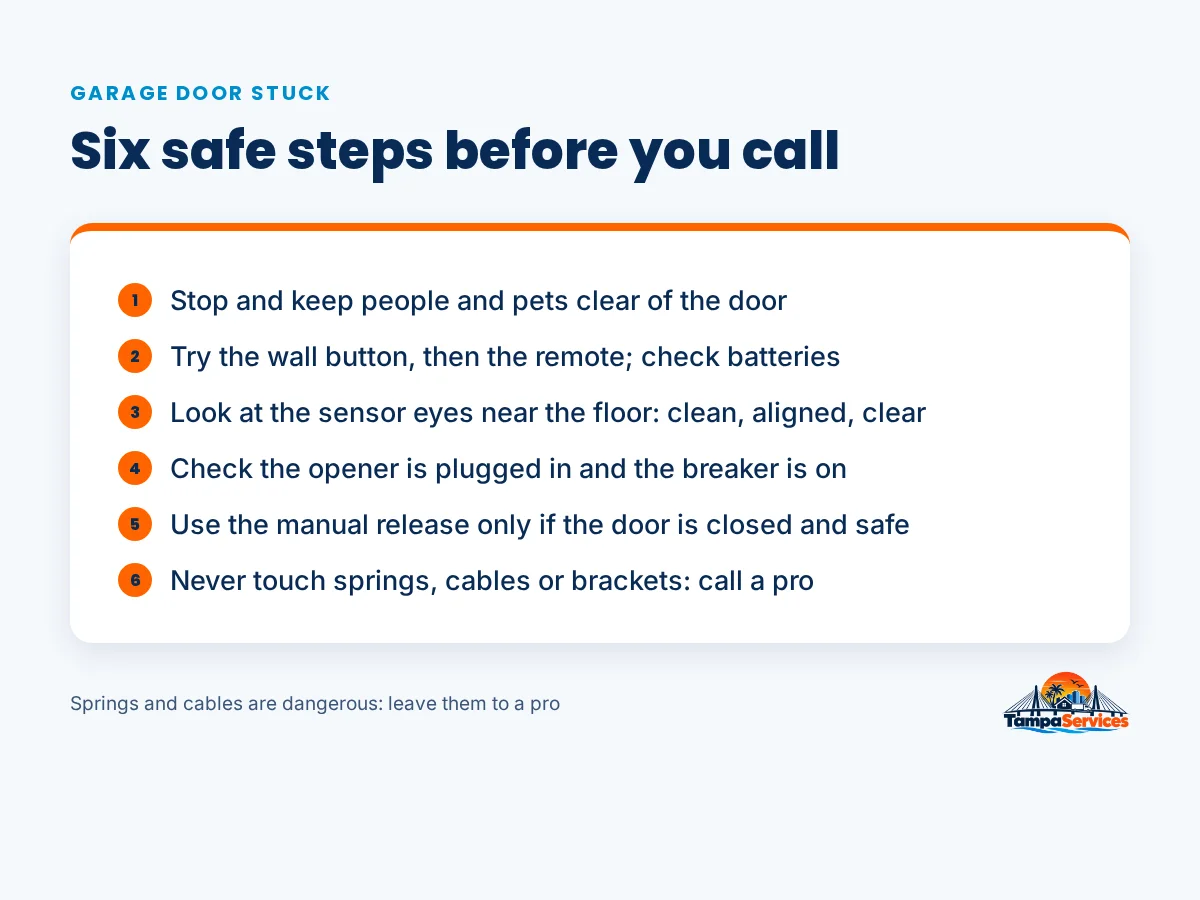
Safe checks you can do in a few minutes
Keep people and pets away from the door first. Then try the wall button and the remote. If one works and the other does not, the problem is probably the remote battery or its pairing. Check that the wall panel's lock or vacation mode is not turned on.
Next, look at the two small sensor eyes near the floor on each side of the door. If the door starts to close and then reverses, or the opener light blinks, they may be dirty, bumped out of line or blocked by something. Wipe the lenses gently and make sure nothing is in the beam. Finally, confirm the opener is plugged in and the breaker has not tripped; after a Florida thunderstorm or power flicker this is common.
The manual release: only if it is safe
Most openers have a red release cord that lets you lift the door by hand. Use it only when the door is fully closed and nothing looks broken. If the door is partly open, hanging crooked, or a spring or cable looks snapped or loose, do not pull the cord or try to lift it, because the door can drop suddenly. Keep clear and call a professional.
What to leave to a professional
Torsion and extension springs, lift cables, rollers on the bottom bracket, bent tracks and door panels that have come off their hinges are professional work. Warning signs include a loud bang from the garage, a visible gap in the spring, a door that feels extremely heavy, or cables hanging loose. Treat these as stop-and-call situations.
Opener replacement is also worth leaving to a professional. Federal safety rules for residential garage door openers (16 CFR Part 1211) cover protection against entrapment, which is why the reversing function and sensor eyes should be tested after any repair.
Repair or replace the door?
A single broken spring, a worn roller or a bad sensor is usually a repair. Replacement comes into the conversation when panels are damaged or rotted, the door has been hit by a vehicle, or repairs keep repeating. In Tampa Bay, wind is a factor: ask whether a replacement door is rated for wind loads and whether the job needs a permit, then confirm with City of Tampa Construction Services or your county building office. Ask for repair and replacement options in writing so you can compare scope, not just price.
Questions to ask before you hire
Ask for the company's license or registration information and check it on the Florida DBPR license search, and ask for proof of insurance. Ask what exactly failed, what the quote includes, what parts and labor are warrantied and for how long, and whether the safety sensors and reverse function will be tested before they leave. Be cautious of anyone who pushes a full replacement before explaining the cause, or asks for a large payment up front.
What to have ready when you request a provider
Your ZIP code, what happens when you press the button, whether the door is open, closed or stuck partway, any noises you heard, the opener brand if you know it, and a few photos. Tampa Services is a marketplace, not a garage door company. We match your request with one eligible local provider for your service and ZIP code, who contacts you. You are not obligated to hire, and you should still check license, insurance and the written scope before you sign.
Frequently asked questions
Why won't my garage door open with the remote?
Common causes are dead remote batteries, a lost pairing, the wall panel lock being on, or no power to the opener. Try the wall button and check the opener's power and breaker.
Why does my garage door close and then go back up?
The safety sensor eyes near the floor are often dirty, misaligned or blocked. Clean the lenses and clear the beam. If it continues, call a professional.
Can I replace a garage door spring myself?
No. Springs hold dangerous tension and can cause serious injury. Spring and cable work should be done by a qualified garage door professional.
Does a new garage door need a permit in Tampa?
It can, especially for replacement doors rated for wind loads. Ask the contractor and confirm with City of Tampa Construction Services or your county building office.
Does Tampa Services repair garage doors?
No. Tampa Services matches your request with one eligible local provider, who inspects the door, quotes the work and performs it under their own license.
Related services
Keep reading
- Garage door repair and installation
- How to compare contractor estimates
- How to verify a Florida contractor license