Commercial HVAC Service in Tampa: What to Ask

By Aaron Hurlburt · Last reviewed 2026-11-05
Commercial AC down in Tampa? Know who pays, what to ask a licensed Florida AC contractor, and how to compare repair and replacement options in writing.
The short answer: get the facts, then ask the right questions
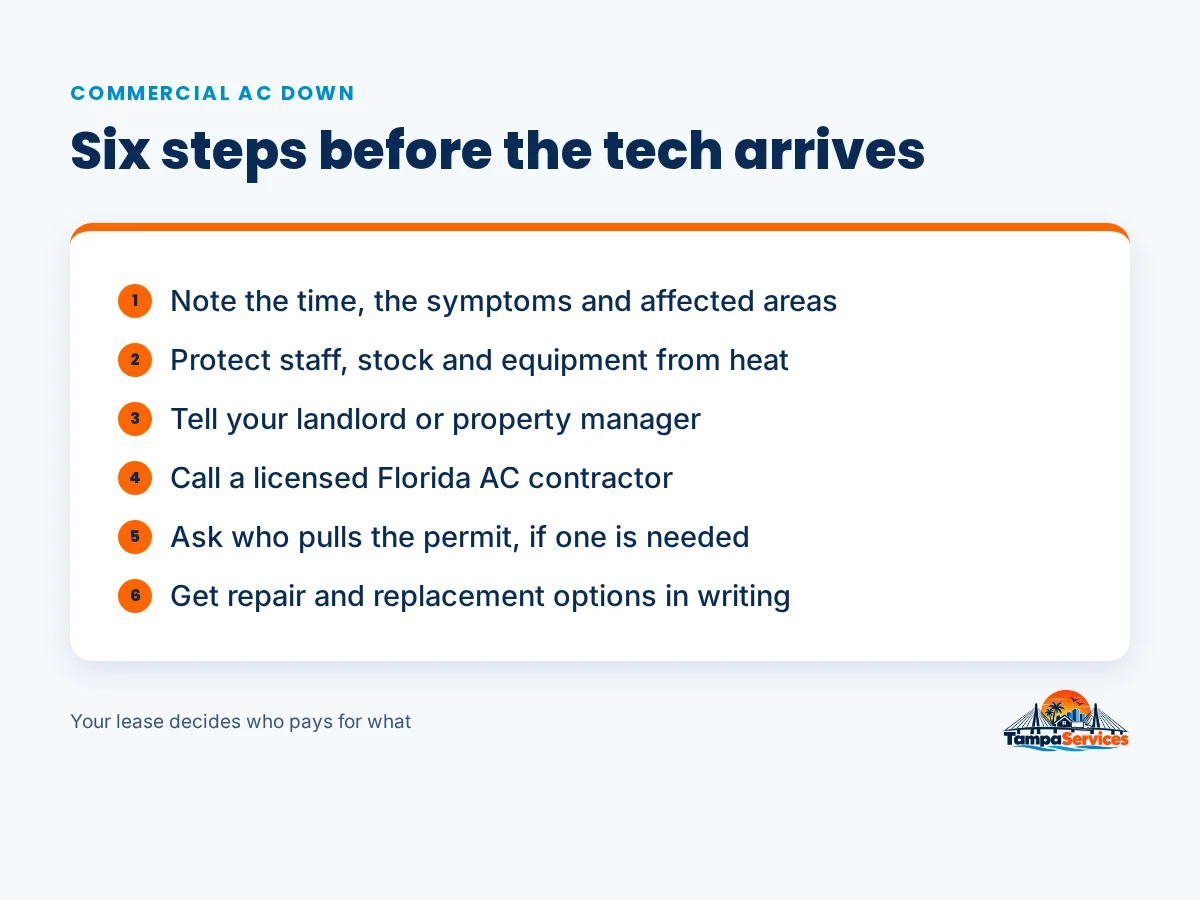
When the air conditioning fails at a Tampa office, shop or restaurant, the pressure is immediate: customers are uncomfortable, staff are hot, and stock or equipment may be at risk. A few minutes of preparation makes the service call faster and the quote easier to judge. Write down what you see, protect what you can, find out who is responsible under your lease, and then call a licensed Florida air conditioning contractor.
This guide is about the service visit itself. If you are still choosing a long-term contractor, see our guide to hiring a commercial HVAC contractor, and for ongoing upkeep see commercial HVAC maintenance plans.
- How to hire a commercial HVAC contractor in Tampa
- Commercial HVAC maintenance plans for restaurants and offices
What to note before you call
Describe the problem as precisely as you can. Is the system not running at all, running but not cooling, cooling unevenly, freezing up, leaking water or making unusual noises? Which zones or suites are affected? When did it start, and did anything happen first, such as a power flicker, a storm or a recent service visit? If the thermostat or building controls show an error code, photograph it.
Also gather the basics a technician will ask for: the building address, the type of equipment (rooftop unit, split system or chiller, if you know), its approximate age, and the last service date. Photos of the equipment's data plate help. Don't remove panels or work on electrical or refrigerant components yourself; that work belongs to licensed professionals.
Who is responsible: owner, landlord or tenant?
In leased space, your lease usually decides who maintains and replaces the HVAC equipment and who pays for repairs. Some leases make the tenant responsible for service contracts; others leave major repairs to the landlord. Read the HVAC and maintenance clauses before you authorize work, and tell your landlord or property manager right away. Some require their own approved vendor or written approval first.
If you manage several locations, keep a simple record for each: equipment type, service history and who to call. It saves time when something fails.
Confirm the contractor's Florida license and insurance
Florida requires a state license for air conditioning contracting, and the Department of Business and Professional Regulation (DBPR) lets you look up a license by name or number. Ask for the license number, check that it is current and active, and make sure the company on your estimate matches it. Ask for a current certificate of insurance, and if your building requires one, have the certificate list the property owner or manager.
Technicians who handle refrigerants must also hold the federal certification required by the EPA's Section 608 program. It is reasonable to ask.
- Florida DBPR license search
- EPA Section 608 refrigerant management
- How to verify a Florida contractor license
Repair or replace? Ask for both options in writing
Diagnosing first matters. A good technician explains what failed, why, and what it takes to fix it, and doesn't recommend replacement before finding the cause. When equipment is older, repairs are repeating, or a major component such as a compressor has failed, ask for both a repair option and a replacement option, each described in writing.
Useful questions: What exactly failed? What is the repair scope and what is excluded? Does the repair or the new equipment carry a warranty, for parts and for labor, and for how long? How long will the work take, and can it be scheduled around business hours? What happens if the technician finds a second problem once work starts? Compare scope and terms, not only the bottom line, and see our guide on comparing contractor estimates.
Permits and inspections
Replacing commercial HVAC equipment can require a mechanical permit, while some small repairs may not. Ask the contractor whether the job needs one and who will pull it, then confirm with City of Tampa Construction Services or your county building office. A contractor who asks you to pull the permit under your own name should prompt more questions.
Payment terms and paperwork
Ask for the scope, schedule and payment terms in writing before work starts. Be cautious of large up-front payments, and under Florida law a contractor generally can't require a deposit above a set percentage of the contract price before starting work; review the statute and talk to the contractor if a request seems high. Keep the invoice, warranty papers, permit documents and any release of lien together in your building file.
What to have ready when you request a provider
Your business address and ZIP code, the type of space, the symptoms, the equipment type if known, how urgent it is, and whether the landlord is involved. Tampa Services is a marketplace, not an HVAC contractor. When you submit a request, we match it with one eligible local provider for your service and ZIP code, and that provider contacts you. You aren't obligated to hire, and you should still check the license, insurance and written scope before you sign.
Frequently asked questions
What should a Tampa business do first when the AC stops working?
Note the symptoms and affected areas, protect staff, stock and equipment from heat, tell your landlord or property manager, then call a licensed Florida air conditioning contractor.
Who pays for commercial HVAC repairs in a leased space?
Your lease decides. Some leases put maintenance and repairs on the tenant, others on the landlord. Read the HVAC clauses and notify the landlord before authorizing work.
Does replacing commercial HVAC equipment need a permit in Tampa?
Often it can. Ask the contractor whether the job needs a mechanical permit and who pulls it, and confirm with City of Tampa Construction Services or your county building office.
How do I check a commercial HVAC contractor's license in Florida?
Search the contractor's name or license number on the DBPR license search and confirm the license is current and matches the company on your estimate.
Does Tampa Services repair commercial HVAC systems?
No. Tampa Services matches your request with one eligible local provider, who assesses the system, quotes the work and performs it under their own license.
Related services
Keep reading
- Commercial HVAC in Tampa
- How to hire a commercial HVAC contractor in Tampa
- Commercial HVAC maintenance plans
- How to compare contractor estimates